Japanese Milk Bread (Shokupan)
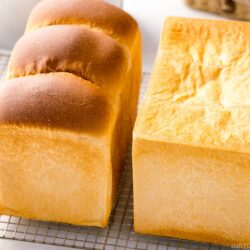
Japanese Milk Bread is possibly the best version of soft white bread! With a milky-sweet taste and pillowy softness, shokupan is enjoyed daily in Japan as breakfast toast and in sandwiches. Here‘s the perfect milk bread recipe in two styles: rounded top and flat top.
Ingredients
For 1 Rectangular Shokupan Loaf (1.5 kin size)
- 250 g warm water (104ºF, 40ºC; in the summertime when the kitchen is warm, use room temp or cold water; read about desired dough temperature in my blog post FAQs)
- 20 g sugar
- 7 g Diamond Crystal kosher salt
- 10 g honey
- 7 g instant yeast (I use 1 packet (7 g each) of Fleischmann’s® bread machine yeast; use every last granule; DO NOT use old yeast that‘s more than 6 months old; to substitute active dry yeast, use the same amount or up to 25% more and proof it first in some of the warm water from above)
- 350 g bread flour (I use King Arthur; conventional flour (not organic) has more consistent protein levels, which means better gluten development and rise)
- 20 g skim milk powder or nonfat dry milk powder (I use Bob’s Red Mill; for vegan, use coconut milk powder; avoid soy milk powder as the dough does not rise well)
- 25 g unsalted butter (at room temperature; for vegan, use Miyoko’s)
For Greasing
- ½ tsp neutral oil (for the bowl)
- 10 g unsalted butter (at room temperature; for the shokupan mold; or use cooking oil spray)
For 1 Square Shokupan Loaf (1 kin size)
- 167 g warm water
- 14 g sugar
- 4.5 g Diamond Crystal kosher salt
- 7 g honey
- 4.7 g instant yeast
- 235 g bread flour
- 14 g skim milk powder or nonfat dry milk powder
- 17 g unsalted butter
Instructions
Before You Start
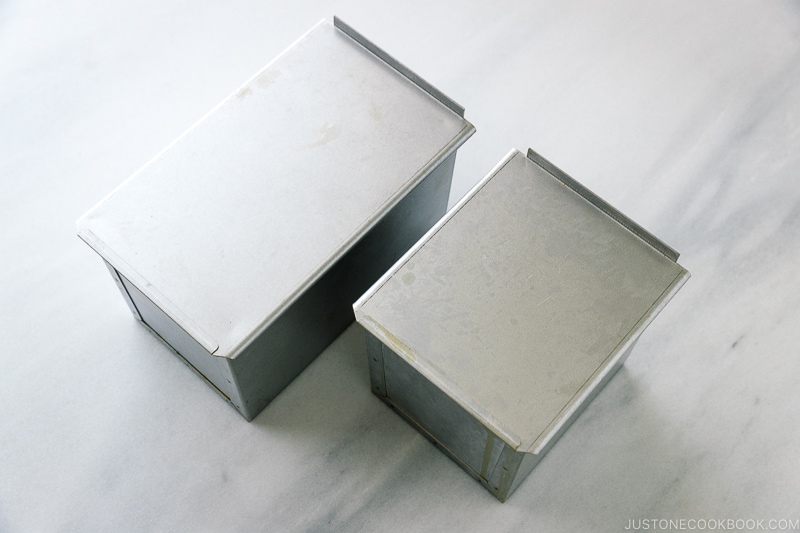
- Shokupan Molds: The rectangular shokupan mold is 4.7 x 7.8 x 5.1 in. (12 x 20 x 13 cm), approx 2900 ml. The square shokupan mold is 4.7 x 5.3 x 5.1 in. (12 × 13.5 × 13 cm), approx 1900 ml. I have written an extensive post about Japanese shokupan molds and how to order them. If you don't go for an ideal shokupan size, a standard 1 lb loaf pan works too—follow the rectangular loaf recipe.
- Stand Mixer: My instructions are for a KitchenAid 5-QT Artisan Series (325 watts). KitchenAid Classic Series: Do not double the recipe — the 275-watt motor isn't strong enough. KitchenAid Professional Series with a spiral hook: You must double the rectangular loaf recipe, or there won't be enough dough to engage the hook. With twice the dough, knead 1.5 times longer at each step. Using a different brand? Follow my steps to achieve a dough that passes the windowpane test.Hand Kneading: Watch this video for hand kneading technique.
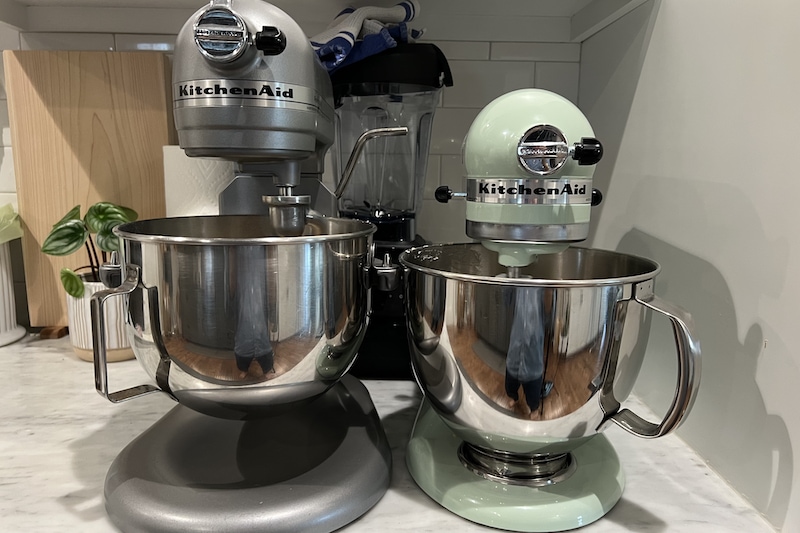
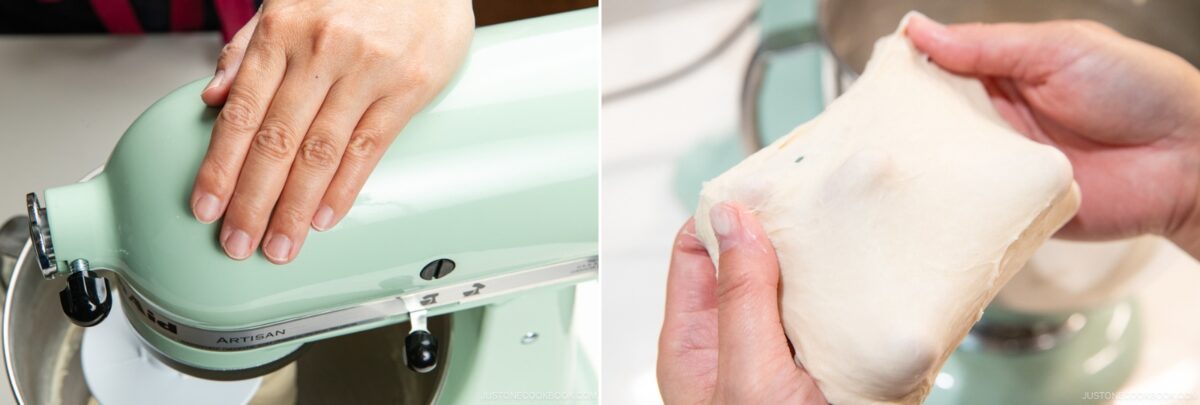
- Warning: KitchenAid does not recommend kneading above Speed 2, but we can't achieve the right texture without it. Hold the mixer down with both hands at Speed 6 and never walk away. Use at your own discretion.
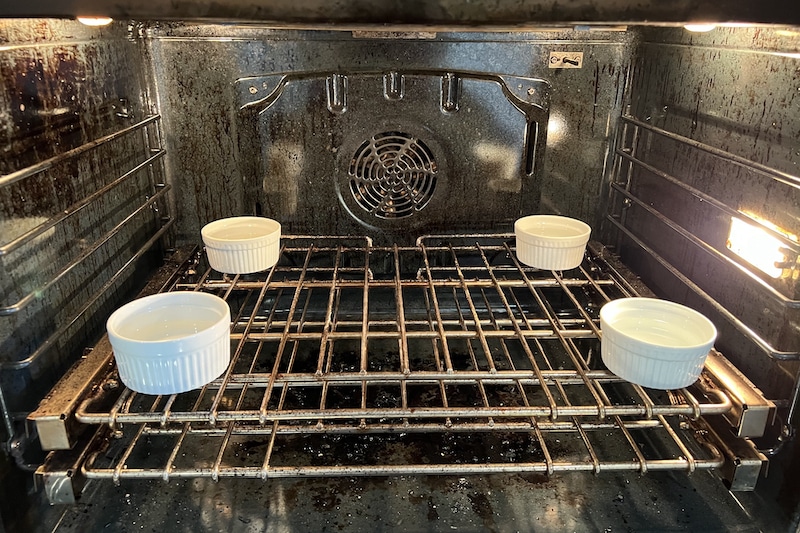
- Warm Environment for Bulk Fermentation: Use your oven's Proof setting at 100ºF (38ºC). No Proof setting? Place small dishes of boiling water on the lower-middle rack at the four corners, set your dough bowl in the center, and close the door. An Instant Pot on Yogurt (Low) mode also works. In summer, you may not need any of this.
To Make the Dough
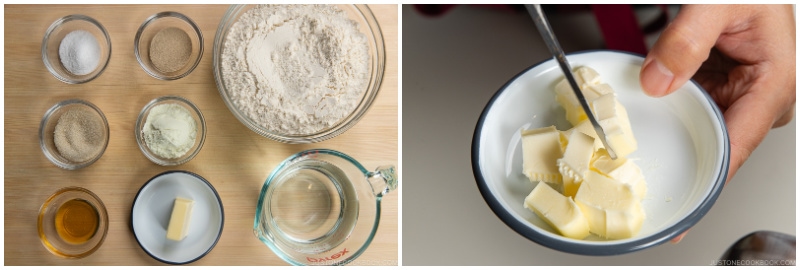
- Gather all the ingredients. Weigh your ingredients with a digital kitchen scale—precise measurement is critical, and volume measurements will affect results.Cut 25 g unsalted butter into small cubes.(For a square loaf: 17 g unsalted butter.)
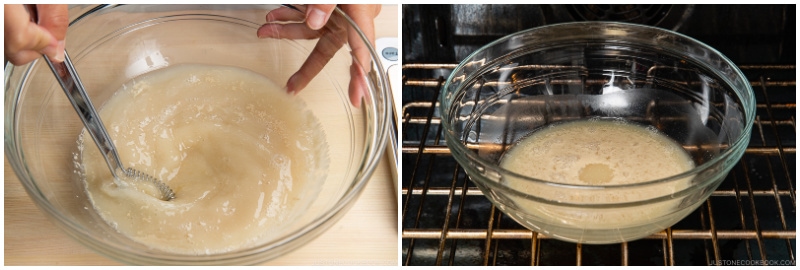
- In a large bowl, combine 250 g warm water, 20 g sugar, 7 g Diamond Crystal kosher salt, 10 g honey, and 7 g instant yeast and whisk together. (For a square loaf: 167 g warm water, 14 g sugar, 4.5 g Diamond Crystal kosher salt, 7 g honey, and 4.7 g instant yeast.)Set aside in a warm place for 10 minutes. The surface should be covered in bubbly foam. Nami's Tip: If you don’t see any, maybe your yeast is old or the environment is not warm enough; wait another 5 minutes to see if any foamy bubbles develop.
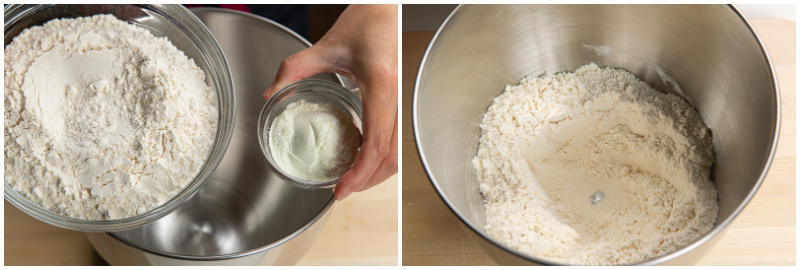
- Meanwhile, combine 350 g bread flour and 20 g skim milk powder or nonfat dry milk powder in a stand mixer bowl and mix it together.(For a square loaf: 235 g bread flour and 14 g skim milk powder or nonfat dry milk powder.)Make a well in the middle of the flour mixture.
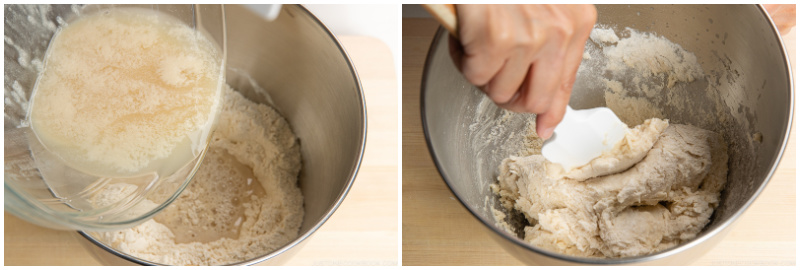
- Pour the foamy yeast mixture into the well, scraping out every bit of liquid with a silicone spatula. (Keep this bowl for later.) Mix until a shaggy dough forms.
To Knead the Dough in the Stand Mixer
- Set up the stand mixer with a dough hook attachment. Knead on Speed 2 for 2 minutes (or 3 minutes for double the rectangular loaf recipe). The dough should come together into a shaggy, rough mass with no dry flour remaining.
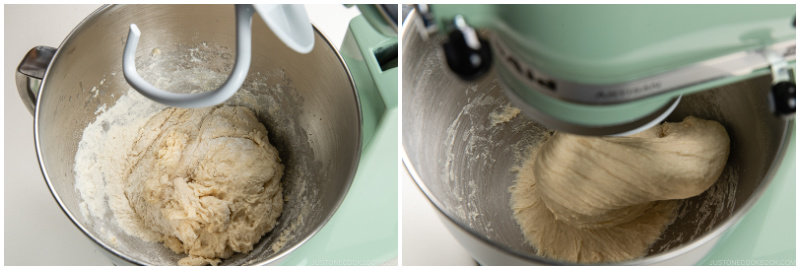
- knead on Speed 4 for 4 minutes (or 6 minutes for double). Stop the mixer to check the dough. It will be smoother than before, yet still a bit rough and bumpy.
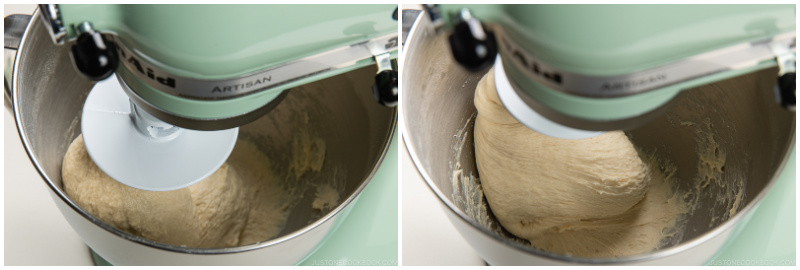
- Add the butter cubes to the dough. Knead again on Speed 2 for 2 minutes (or 3 minutes for double), or until you no longer see any butter streaks.
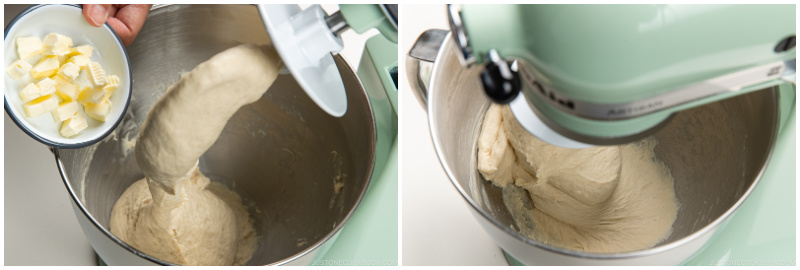
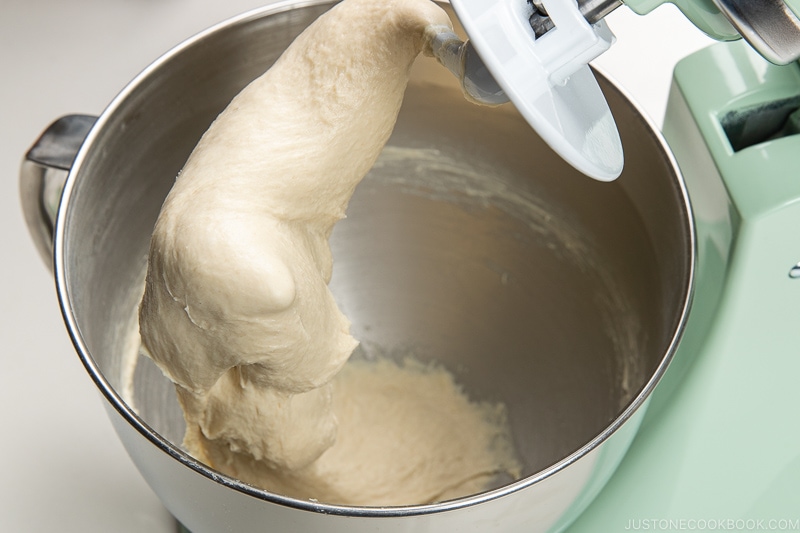
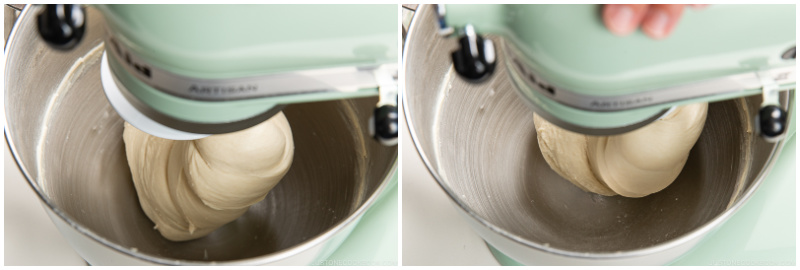
- Knead on Speed 4 for 4 minutes (or 6 minutes for double). While spinning, the dough will stretch and elongate (see the photo below).
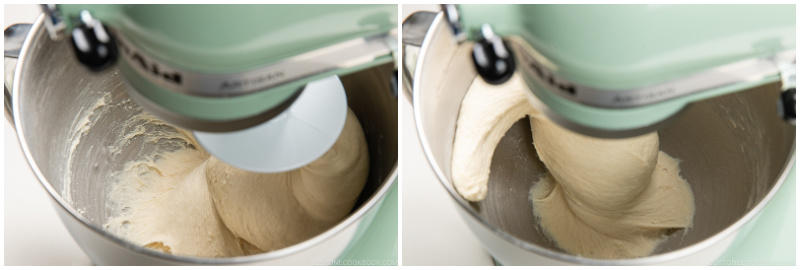
- Stop the mixer and check the dough's texture. It should be smoother, shinier, softer, and thinner when it’s stretched. At this stage, the dough is still attached to the bottom of the mixer bowl.
- Knead the dough on Speed 6 for 3 minutes (or 4½ minutes for double). Nami's Tip: From here, you MUST hold down your stand mixer with your hand(s) since the machine will shake and move and may possibly fall off the countertop.
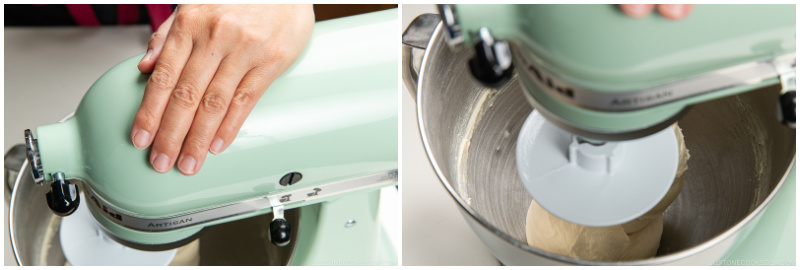
- Vigorous kneading develops the gluten (elasticity)—lengthening and stretching strands in the dough to give shokupan its soft, tender texture.
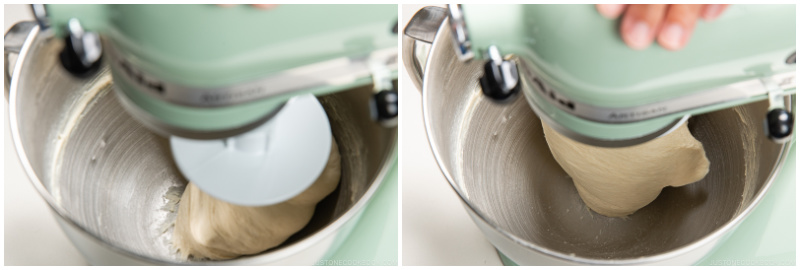
- The dough will start to pull away from the bottom of the bowl and eventually become a solid ball shape.
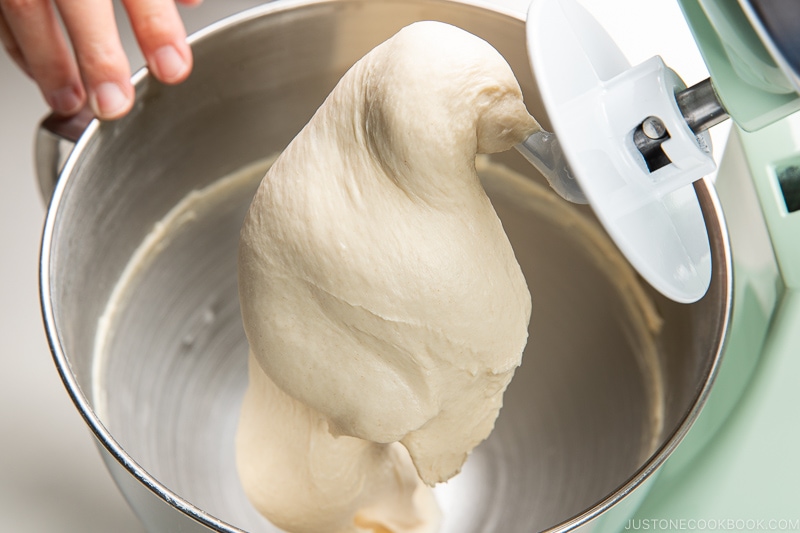
- Gradually reduce the speed, then stop the mixer. The dough should look shiny, silky, soft, and smooth (not sticky). When you lift the dough hook, it should pick up all the dough in one piece, separating easily from the bottom of the bowl. Nami's Tip: If the dough becomes slack and gooey, you‘ve kneaded the dough too long.
To Use the Windowpane Test
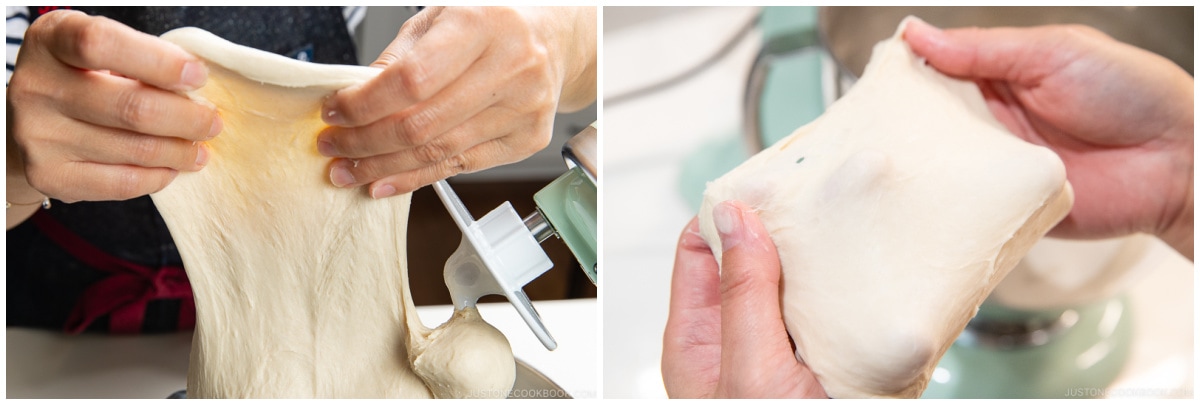
- Pull on a part of the dough or tear off a small piece for windowpane test. Hold it in both hands and gently stretch it into a square with your fingers.If it's elastic, smooth, and shiny—and stretches to a super-thin membrane without tearing so light passes through the center—your dough passes the test.If it tears too easily or won't stretch, knead again on Speed 6 for 1 minute and test again.
To Check the Dough Temperature (optional)
- Insert an instant-read thermometer into the center of the dough. The finished dough temperature should be 78–82ºF (25–28ºC).Nami's Tip: If your dough comes out warmer than target temp, a short 15-minute fridge rest can help, or let it slowly rise for the First Rise (Bulk Fermentation) without oven's Proof setting (100ºF / 38ºC). Yeast should be most active at 82–95ºF (28–35ºC) during the First Rise (Bulk Fermentation).
To Slam and Fold
- Lightly dust the work surface and your hands with flour. Scrape the dough from the bowl onto the work surface with the dough scraper. From this point, make sure to keep one smooth surface on your dough ball at all times. My smooth surface is currently on the bottom of the dough.
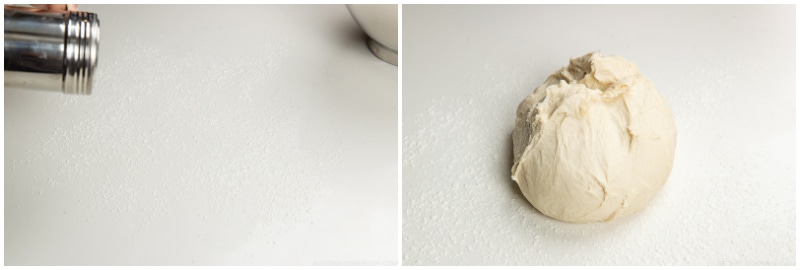
- Scoop up the dough ball, facing the smooth side up. Slam the smooth side onto the work surface. Bang!
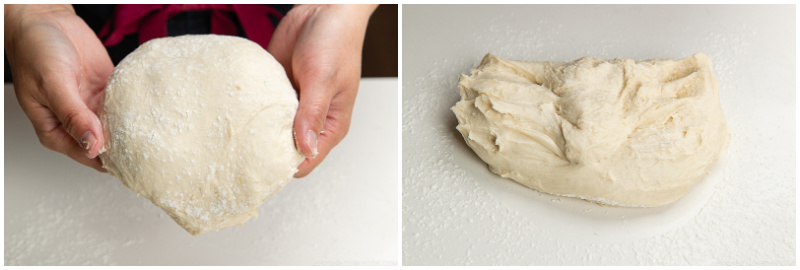
- Hold the far edge of the dough and fold it toward you to the near edge, revealing the smooth surface. Pick up the dough with the smooth side up.
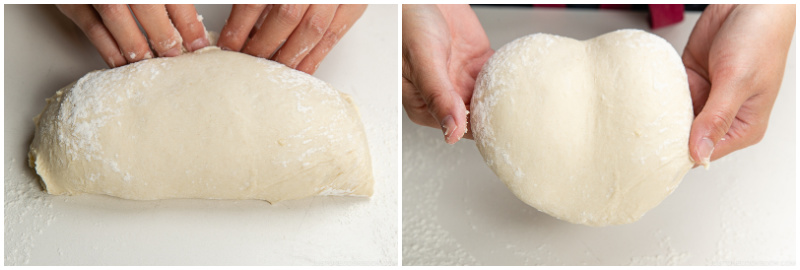
- Slam the smooth surface onto the work surface again. Bang! Hold the far edge of the dough and fold it over to the near edge, revealing the smooth surface.
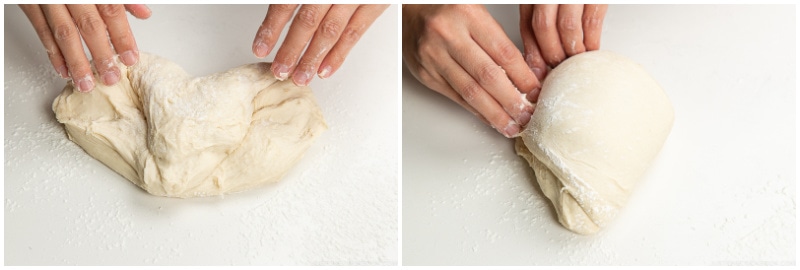
- Pick up the dough with the smooth side up. Repeat this “slam and fold“ process 5 times. After you slam the dough for the final time, leave the dough on the work surface temporarily, and don‘t fold it over yet.
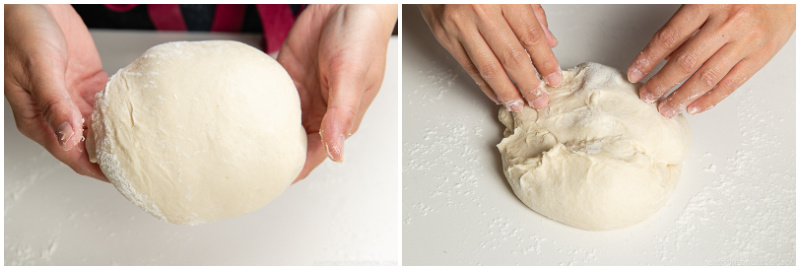
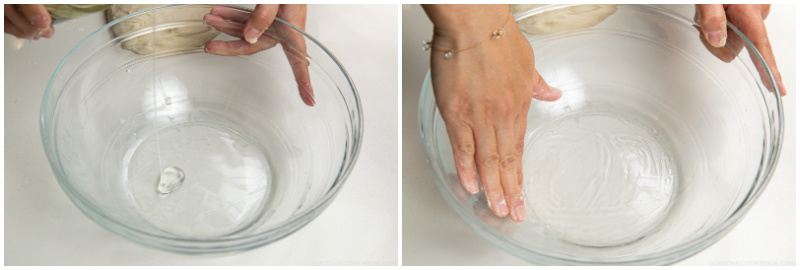
- Thinly coat the reserved bowl with ½ tsp neutral oil. Wipe off any excess oil from the bowl and your fingers with a paper towel.
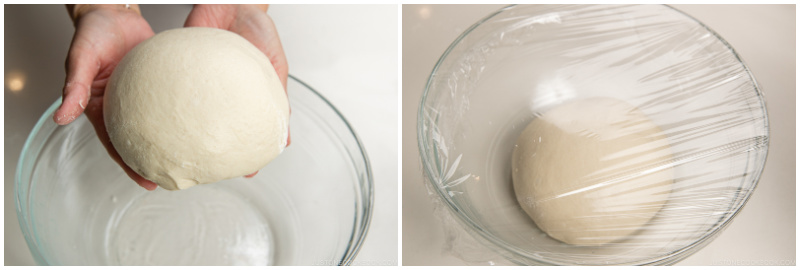
- Fold the dough over one last time. Pick it up and pull the edges from all sides to create a smooth, taut skin. Tuck and pinch the edges underneath to hide them at the bottom. Put the dough ball in the bowl and cover it with plastic.
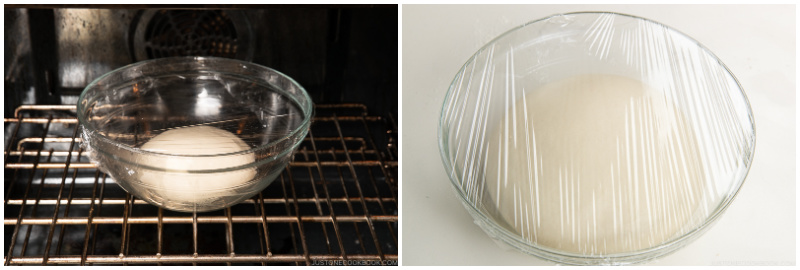
The First Rise (Bulk Fermentation)
- Place the bowl in a warm environment and let the dough rise for 40–45 minutes or until it triples in size. If you live in a cool climate, it may take longer (1–1½ hours). I use the Proof setting on my oven at 100ºF (38ºC). Nami's Tip: If the top of your dough seems flat, you can gently reshape into a tall dome ball and return it to the warm place.
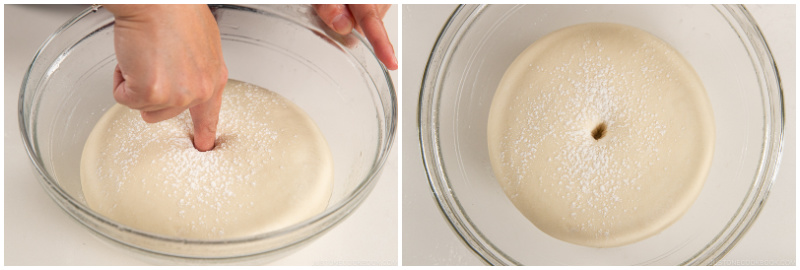
To Use the Finger Test
- Dust some flour on top of the dough and use your index finger to poke the middle of the dough. If the slight indentation remains visible, or indentation slowly springs back, it’s ready. If it springs back immediately, or the dough feels tight and elastic, proof the dough a little longer and test again.
To Deflate the Dough
- Invert the bowl to release the dough onto your work surface. Gently press down and deflate the air bubbles in the dough. Nami's Tip: Remember to keep one smooth surface on your dough at all times. My smooth surface is currently on the bottom of the dough.
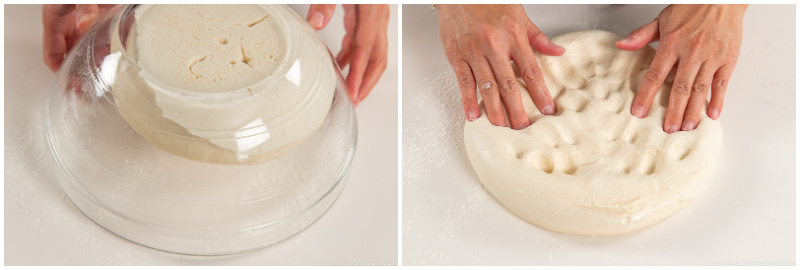
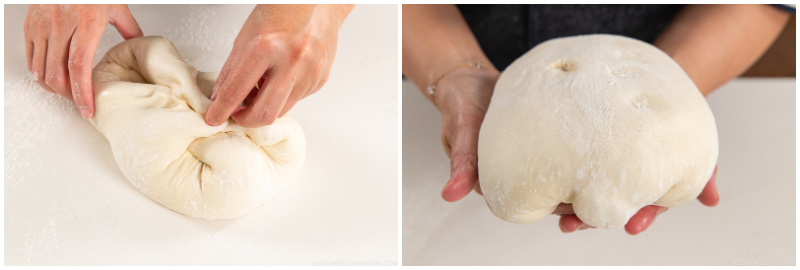
- Collect and press all the edges into the middle, flip the dough, and form a round shape, tucking any loose edges underneath.
To Divide the Dough
- Using a kitchen scale, weigh the dough. Divide it with the dough scraper into 3 equal pieces for a rectangular shokupan loaf (or 2 equal pieces for a square shokupan loaf).
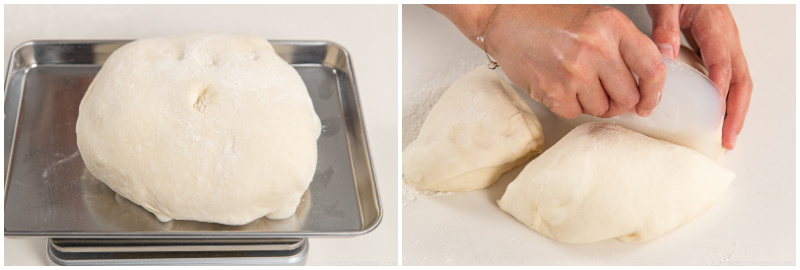
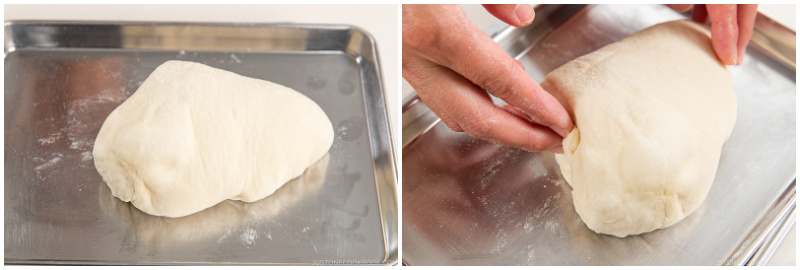
- If you have a piece that‘s bigger, tear off some dough from the edge, keeping the smooth surface intact, and attach it to the edge of the smaller piece.
To Shape into Boule (Round Balls)
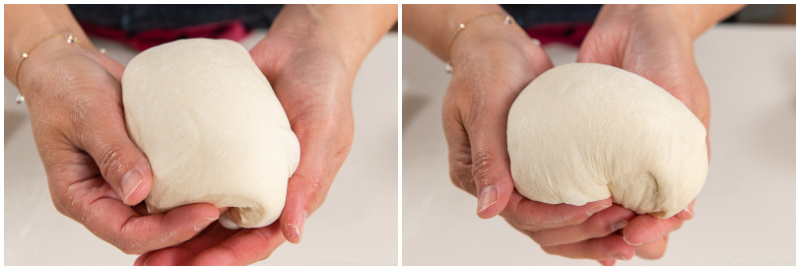
- Hold the dough with the smooth surface on top. Gently pull the dough down from 4 sides to create a round shape.Place the dough on a non-floured surface. Place both of your hands behind the dough and drag it along the work surface 2 inches (5 cm) toward you (see this video). Rotate the ball a quarter turn and perform another gentle drag toward your body, total 6 times from all sides, to form a ball with a smooth, taut skin. For an even rise, use roughly the same pulling action for each ball, or until the dough is sufficiently taut and uniformly round.Repeat this process for the other pieces. Nami's Tip: The bottom of the dough sticks to the dry surface, creating tension and tightening the ball.
The Bench Rest
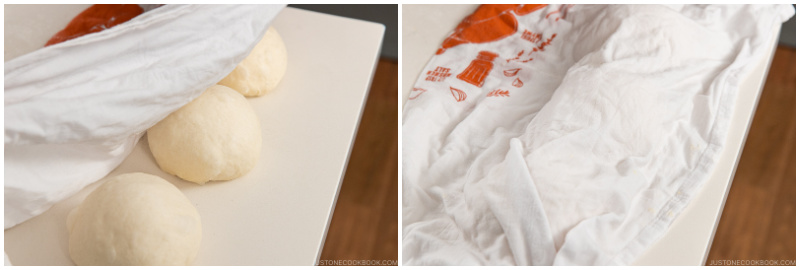
- Cover the dough balls with a damp towel and rest them for 15 minutes. The dough will relax and puff slightly—it should feel softer and more pliable when you press it gently.
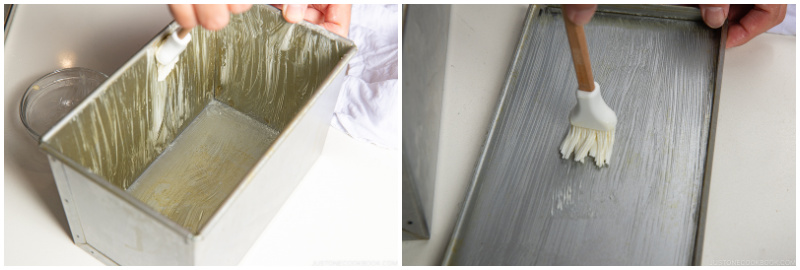
- Meanwhile, grease the shokupan mold and the lid (if you‘re making flat-topped shokupan) with a thin coating of 10 g unsalted butter. Nami's Tip: I like the taste of butter on the crust, but you can use cooking oil spray instead, if you prefer.
To Shape the Dough into a Rectangle
- Take out one dough ball, keeping the rest under the damp towel. Be careful not to pull or stretch the dough.Dust just enough flour so your dough does not stick to the work surface and rolling pin, but not so much that your dough slides around. As you practice, you will know how much flour is just enough. Place the rolling pin in the middle of the dough and press it down.
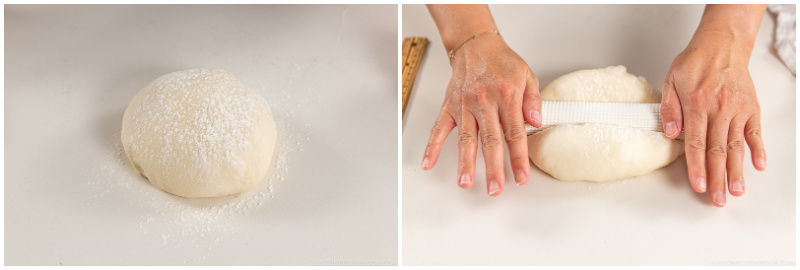
- Roll the dough away from you all the way to the top edge, releasing the gas inside. Roll back toward you all the way to the bottom edge. Use the heel of your hand to press down any thick edges and pop any air bubbles.Nami's Tip: If the dough slides around, you dusted too much flour. I love using a nonstick rolling pin; you can buy a similar one from Amazon.
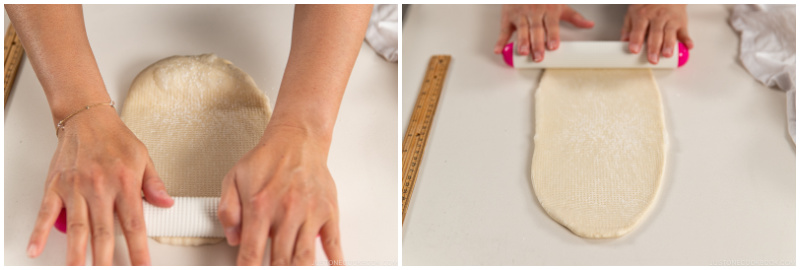
- Pick up the dough. Rotate it 90 degrees and flip. It's laid out in front of you in a horizontal oval shape.
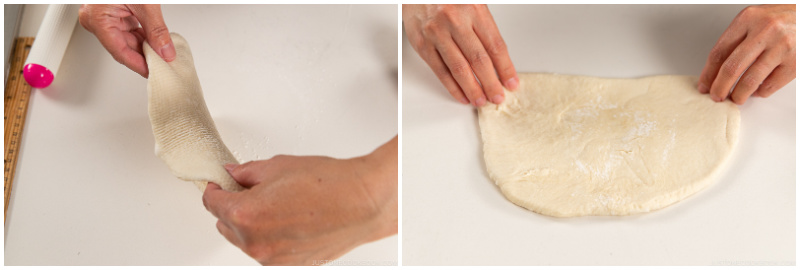
- Roll the four corners of the dough to shape the oval into a rectangle, placing the rolling pin in the middle.
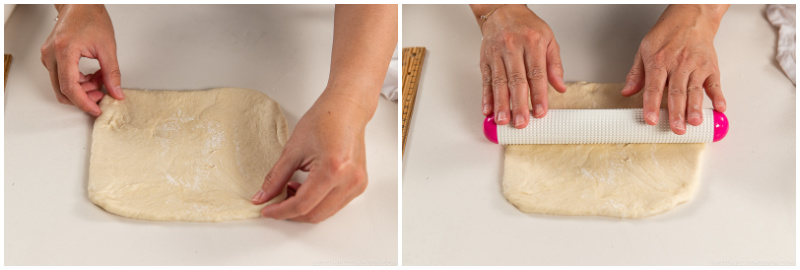
- Roll out the dough away from you and back toward you, pressing through all the edges. Lift the dough from the work surface and let it relax.
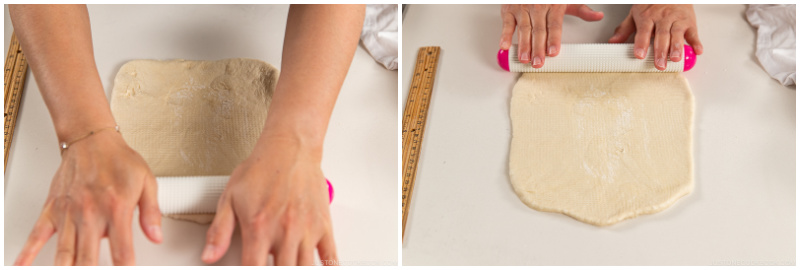
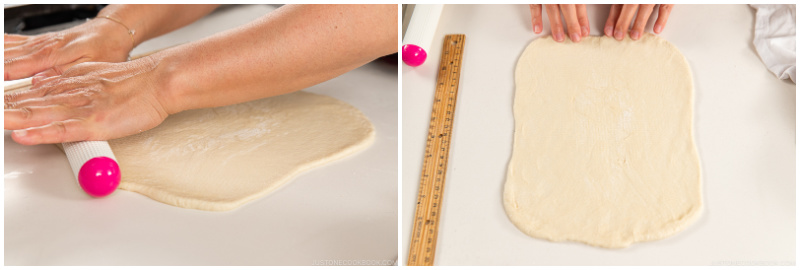
- Roll out the upper two corners so they're less rounded, then the lower two corners. The dough is now a vertical rectangle.
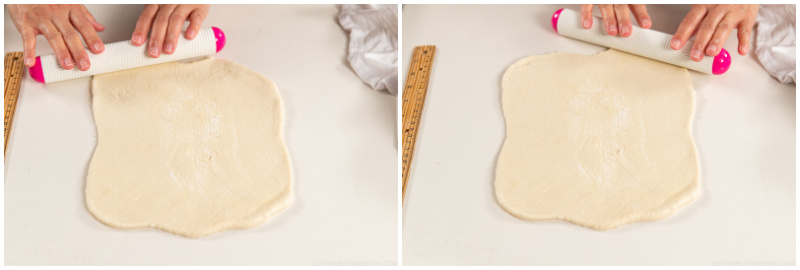
- Roll the dough to an even thickness from edge to center. Lift it from the work surface to release any tension and let it relax.The rectangle should measure roughly 8 x 10 in. (21 x 26 cm).
To Make the Dough Rolls
- Fold the dough in thirds lengthwise. Bring the right third of the dough to the left one-third line, lightly and gently pressing the edge down so it stays in place. Fold the left third of the dough, overlapping the right third by two-thirds. The edge of the left third should be slightly past the center line. Nami's Tip: If the dough sticks, detach it gently — do not pull it or the surface will tear.
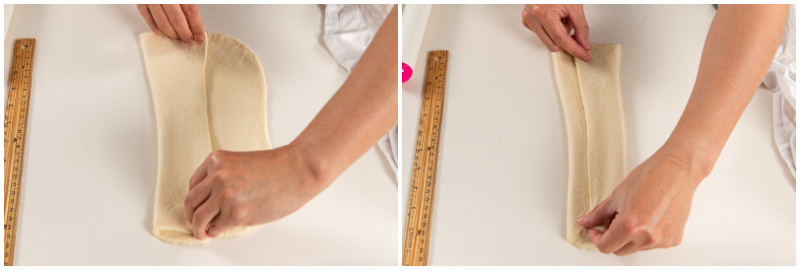
- Press down and seal this edge with your fingers to have an even thickness, from top to bottom. Both the right and left horizontal edges are thicker (puffed up), but the overlapped edges near the center even out the thickness of the dough.
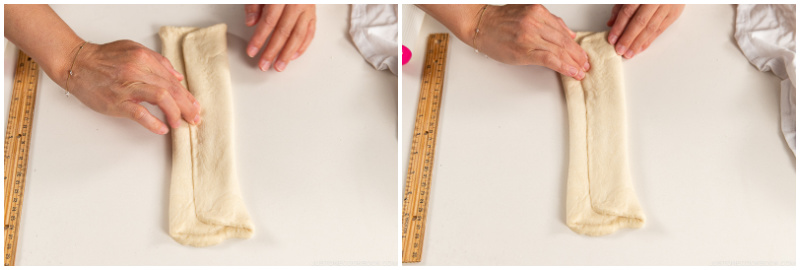
- Fold down the two upper corners toward the center line, so the top now looks like a triangle tip. Tuck the tip down toward you, making sure it is right in the middle.
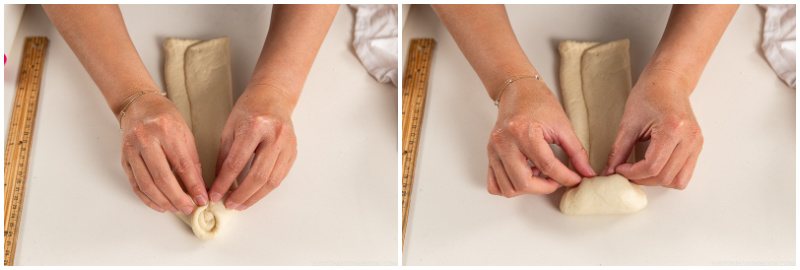
- Start rolling the dough slowly toward you, gently pulling the dough downward as you roll to create a smooth and taut skin, but don‘t roll too tightly. Nami's Tip: Use the same amount of tension when making all of your dough rolls. This helps them rise at the same rate during the final proof and for an ideal round-topped shokupan shape.
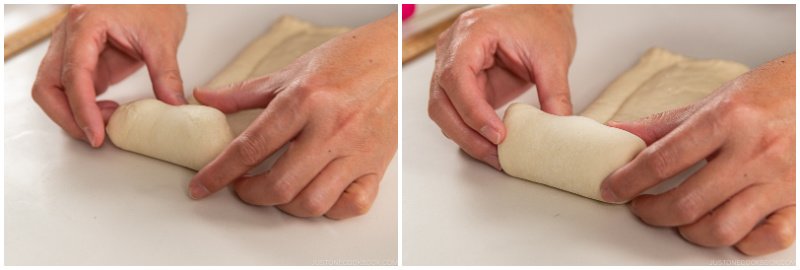
- Pinch the dough edge to seal. Place the rolled-up dough under the damp towel, seam side down, and repeat rolling up the rest of the dough balls.Nami's Tip: Remember which piece of dough you rolled last.
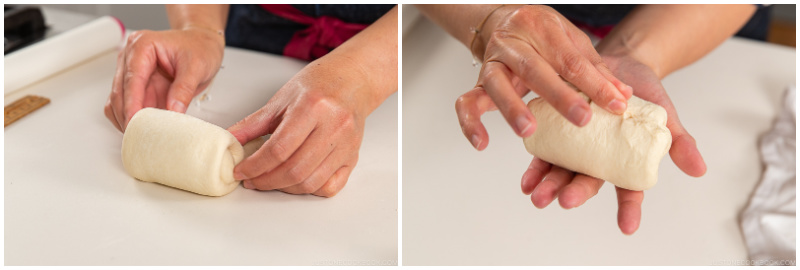
To Fill the Shokupan Mold
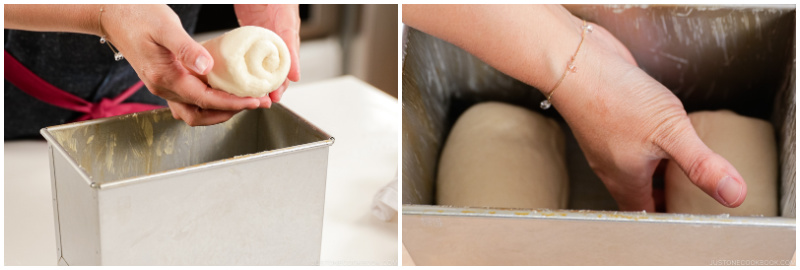
- For the rectangular shokupan mold, place the first dough roll on one side of the mold, seam side down, with the swirl facing toward the middle of the mold and the roll's side touching the mold's wall.
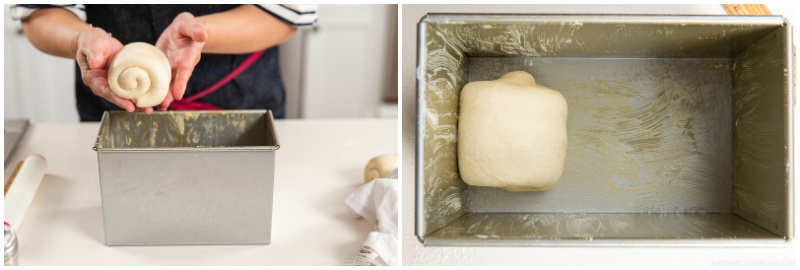
- Place the second dough roll on the opposite end of the shokupan mold, seam side down, with the swirl facing toward the middle of the mold and the roll's side touching the mold's wall.
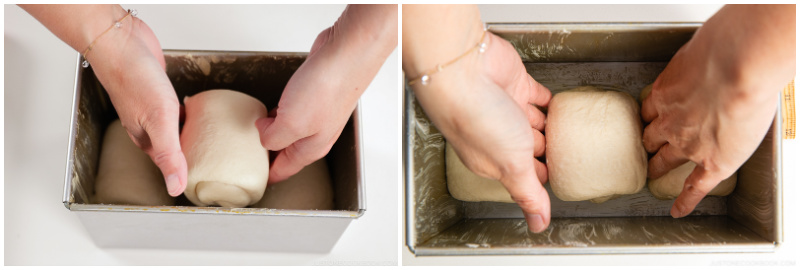
- Place the last piece of dough you rolled between the first two, seam side down. The direction of the swirl can go either way. Gently press the tops of the dough rolls to make them the same height so they rise evenly.
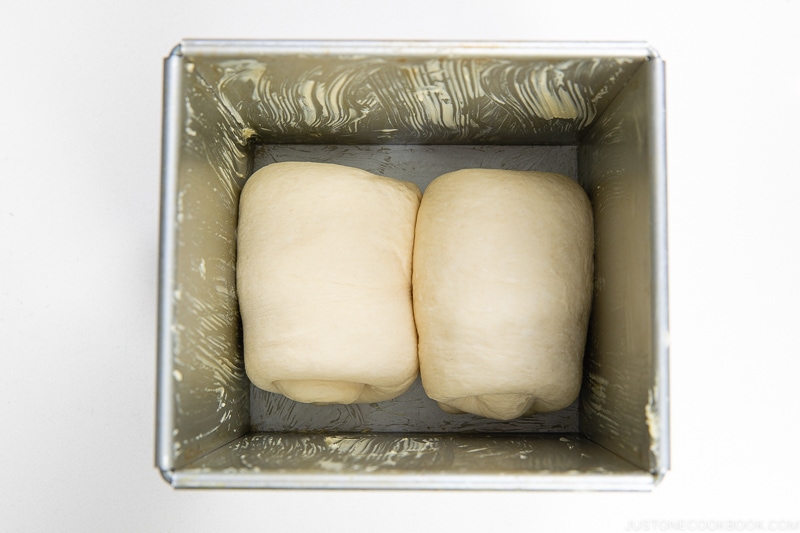
- For the square mold, the two rolls should go in just like the first two rolls for the rectangular mold, swirled toward the center.
The Final Rise (Proofing)
- Cover the shokupan mold with plastic and place in a warm environment for 1 hour or until the dough has risen to 80–90% of the height of the mold. Nami's Tip: I set the timer for 30 minutes. For the first half an hour, I use the Proof mode of my oven. For the rest of time, I transfer the shokupan mold to a warm area of my house while I preheat the oven for baking.
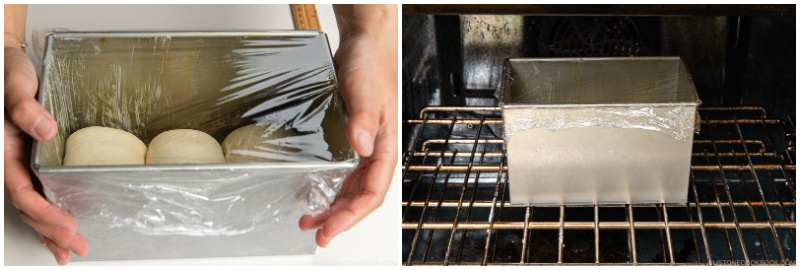
- To make a flat-topped shokupan (角型食パン), let the dough rise to 75–80% of the height of the mold. Remove the plastic and close the lid. If your proof was a bit too long and you exceed 80%, change to a round-topped shokupan. Nami's Tip: Don‘t force the lid closed over the dough. Even if the lid closes, the dough will continue to rise in the oven and the lid will get stuck.
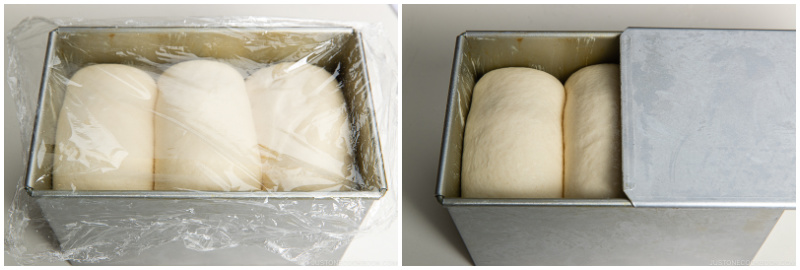
- To make a round-topped shokupan (山型食パン), let the dough rise to 85–90% of the height of the mold. When the highest point of the dough touches the plastic wrap, it’s ready to bake. Remove the plastic and spritz the surface of the dough with water. Note: The volume for each shokupan mold is very different. My 90% may not be the same as yours if we use a different mold.
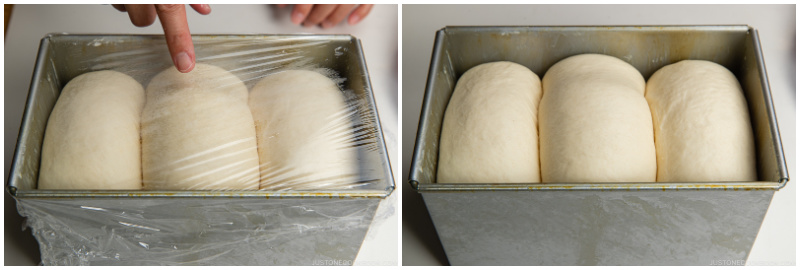
To Preheat the Oven
- Position the rack so the top edge of your shokupan mold sits 6–7 inches (15–18 cm) from the top heating element. Keep at least 6 inches of clearance—any less and the top browns too fast.Preheat the oven to 425ºF (220ºC). For a convection oven, reduce the baking temperature by 25ºF (15ºC).
To Bake the Shokupan
- For the flat-topped shokupan, lower the oven temperature to 410ºF (210ºC) and bake for 25–30 minutes (in my oven, it’s 28 minutes). For the round-topped shokupan, lower the oven temperature to 385ºF (195ºC) and bake for 30 minutes. For a convection oven, reduce the baking temperature by 25ºF (15ºC). For a square loaf, the baking temperature and time should be the same or slightly less.
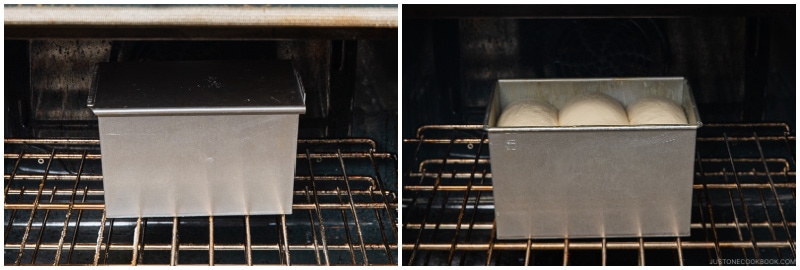
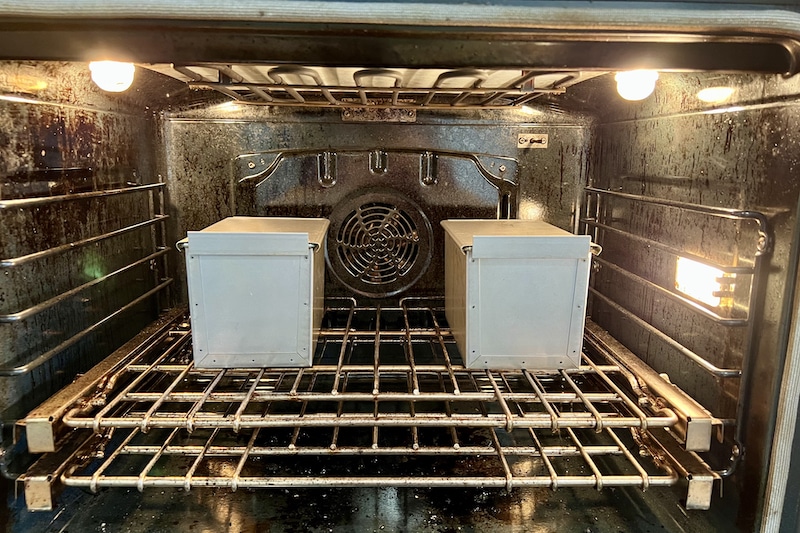
- If you bake two loaves at the same time, bake 1–2 minutes longer and make sure to have plenty of space between the molds so the heat can circulate. Nami's Tip: If the loaf comes out lighter in color, you may also want to increase the oven temperature by 5ºF (2–3ºC) next time. To bake both the flat-topped and the round-topped shokupan together, bake at 400ºF (200ºC).
- As soon as it's out of the oven, drop the mold firmly 1–2 times on the work surface (I use a stovetop grate) to release the steam and prevent the loaf from shrinking. Tip: If steam remains trapped inside, the bread's structure weakens and the sides will wilt and bend.
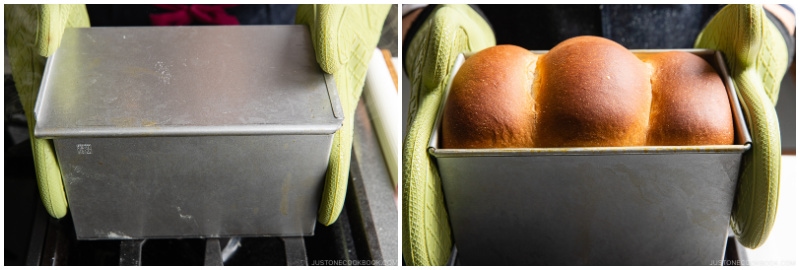
- For the flat-topped shokupan, open the lid carefully. If you struggle to remove the lid, close it and drop the shokupan mold on the work surface one more time. If you still can’t open it, note that you need to stop the second proof earlier next time. Maybe instead of 80%, try 75%.
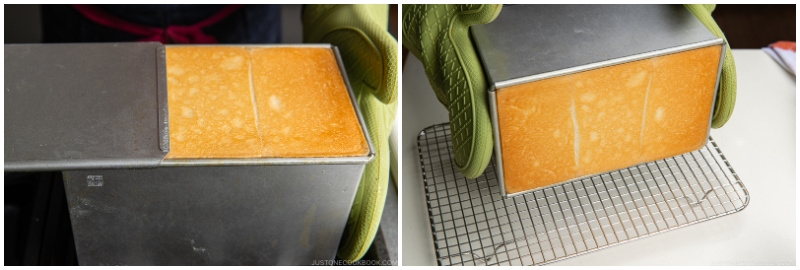
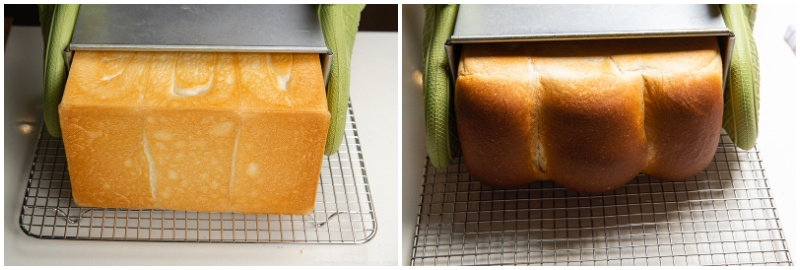
- Hold the mold on its side over the wire rack and thrust it forward firmly a few times until the loaf drops out. Let the shokupan cool completely on the wire rack; it may take 2–3 hours. Do not cut or open the loaf while it’s hot—the steam will escape and the bread will lose moisture. Nami's Tip: After baking, do not wash or soak your Japanese shokupan mold. Simply wipe it off with a paper towel and store it completely dry to prevent rust.
To Serve
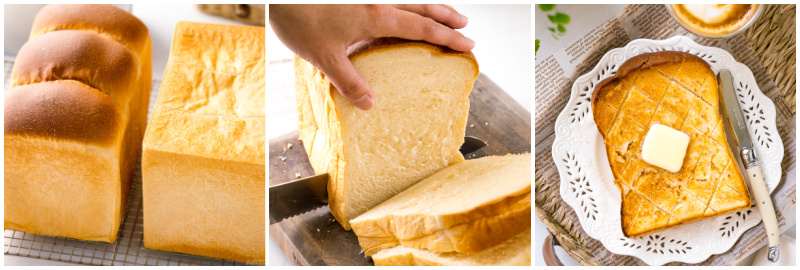
- Slice the cooled bread and toast it to enjoy with butter and jam/honey or use untoasted slices for Japanese-style sandwiches.
To Store
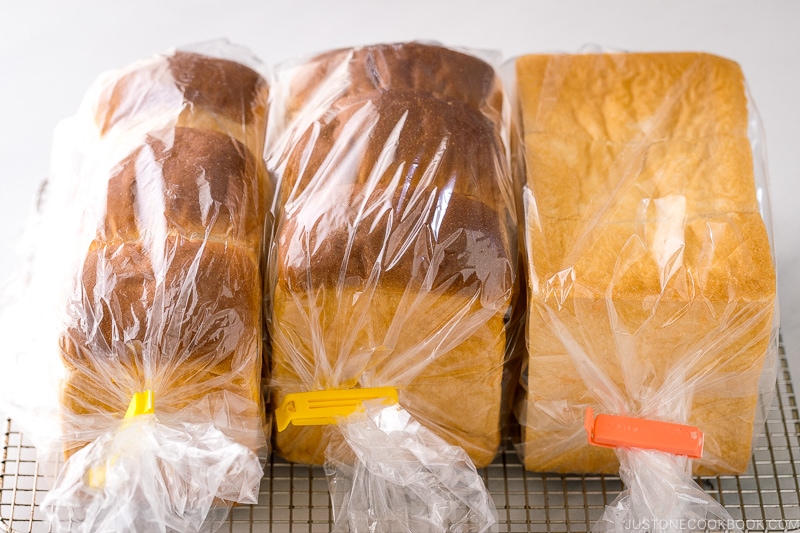
- If you plan to eat the shokupan within 1 to 2 days, put the whole loaf, completely cooled, in a bag (I use clear plastic bags) and slice as needed. If you don‘t plan to eat the shokupan within 2 days, slice and freeze the rest. It's freshest within the first two weeks, but you can freeze it for up to a month.
Notes
Equipment:
-
Rectangular Japanese Loaf Pan or square Japanese Loaf Pan
- Wire rack
- KitchenAid Classic Series: Do not double the recipe—the 275-watt motor isn't strong enough.
- KitchenAid Professional Series with a spiral hook: You must double the rectangular loaf recipe, or there won't be enough dough to engage the hook. With twice the dough, knead 1.5 times longer at each step.
- Using a different brand? Follow my steps to achieve a dough that passes the windowpane test.
Nutrition
Serving: 1.5kin, Calories: 1645kcal, Carbohydrates: 295g, Protein: 52g, Fat: 27g, Saturated Fat: 14g, Polyunsaturated Fat: 3g, Monounsaturated Fat: 6g, Trans Fat: 1g, Cholesterol: 58mg, Sodium: 1355mg, Potassium: 786mg, Fiber: 10g, Sugar: 40g, Vitamin A: 1068IU, Vitamin C: 1mg, Calcium: 348mg, Iron: 3mg
